Our new Food Safe hall: a strong piece of engineering
Since 2024, a completely new installation has been in use that can mix and fill Food Safe chemical products under FSSC 22000 conditions. For an outsider, it may be difficult to estimate which techniques ensure an efficient and food-safe production process. For our process engineers, designing the technology is something that makes their hearts beat faster. Discover the innovative processes we apply in the production of Food Safe Chemistry by Synerlogic Chemicals.
Cutting bags and breaking lumps
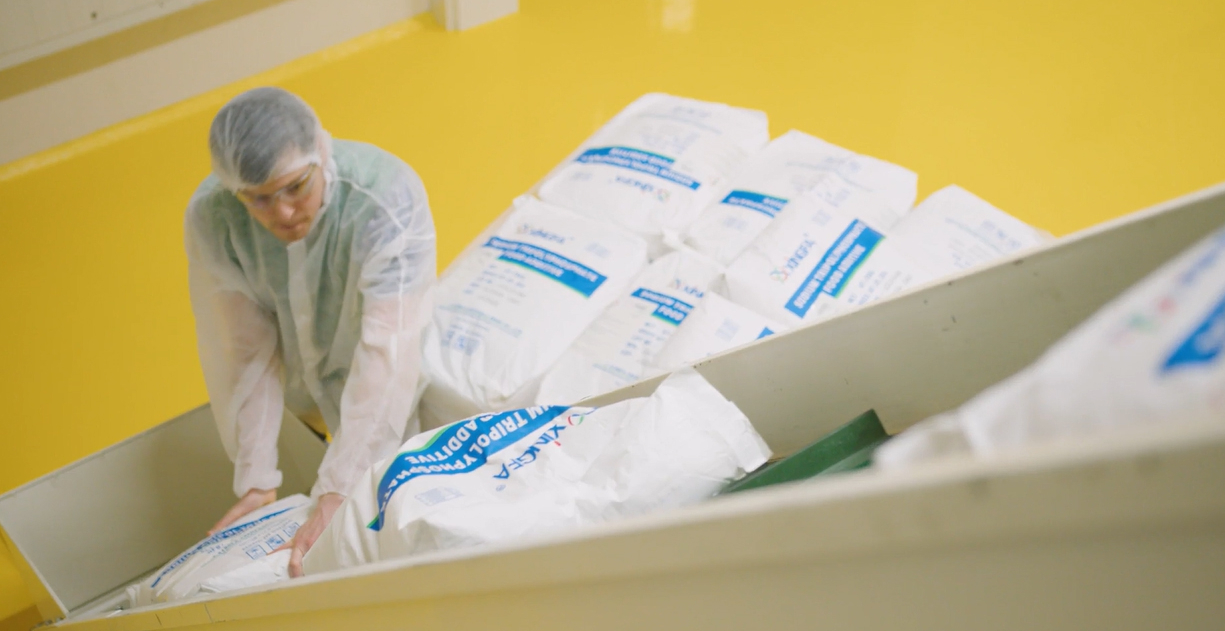
To produce liquid chemistry, such as citric acid, calcium chloride, or potassium sorbate, a powder form is often dissolved. The first step is to prepare the powders for dissolution. To process a high volume of powders, a bag cutting machine is used. This bag cutting machine pours the powder into a first big bag and then, via a lump breaker, the powder is poured into a second big bag.
Dosing powders with jet mixer
For proper dosing, it is important that the powders are first weighed. From the second big bag, the powder is dosed into the mixing process with a jet mixer. What does that look like? The big bag is placed above a buffer hopper, and the powder is sucked up and mixed with water via the jet mixer. The liquid is then dosed into the process tanks.
Dosing liquids and using Venturi technique
In the process tanks, in addition to powders, liquids can also be dosed. This can be done manually, from a tanker truck, or one of our bulk tanks. Frequently requested products that we fill from our bulk tanks are calcium chloride, caustic soda, potassium hydroxide, and phosphoric acid. Direct unloading from the tanker truck to the process tanks in the Food Safe hall is another possibility. For this, we use the Venturi technique. This technique is based on a physical phenomenon of fluid flow in the pipe. Here, the pipe diameter is reduced, causing the speed to increase and the pressure to decrease. At the point where the pressure is low, a connection is made at the jet mixer, allowing the powder to be sucked into the fluid flow and thus dissolved in the liquid.
Two process tanks for mixing to final product
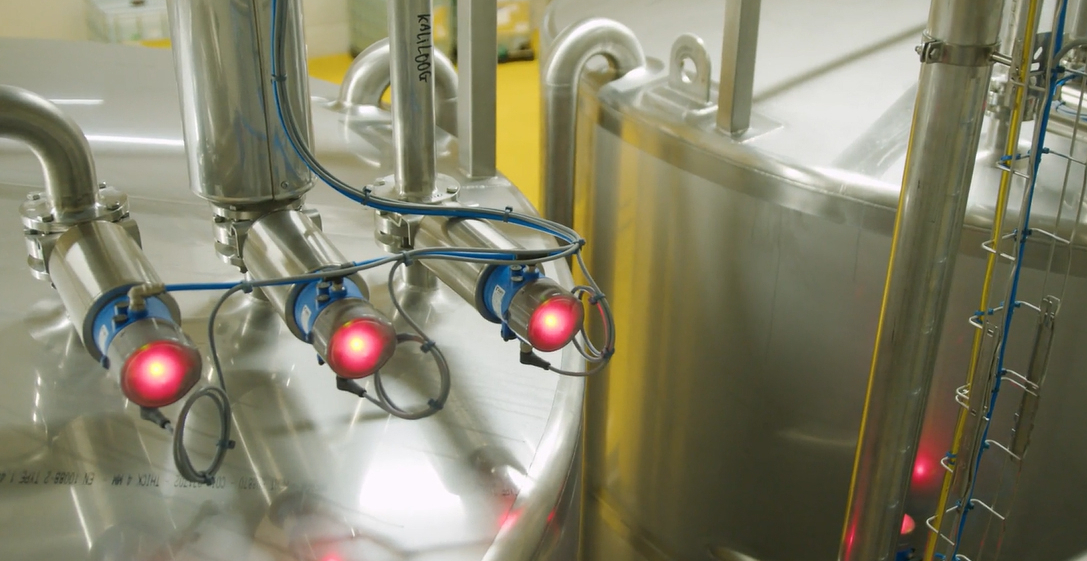
For mixing (or homogenizing) the liquid to the final product, two process tanks with a recirculation system are used. The two process tanks are each 15.000 liters, meaning that between 5.000 and 30.000 liters of products can be made per batch. This provides flexibility to anticipate the (changing) demand for (new) products.
Quality Control and filling from CAN to bulk tank
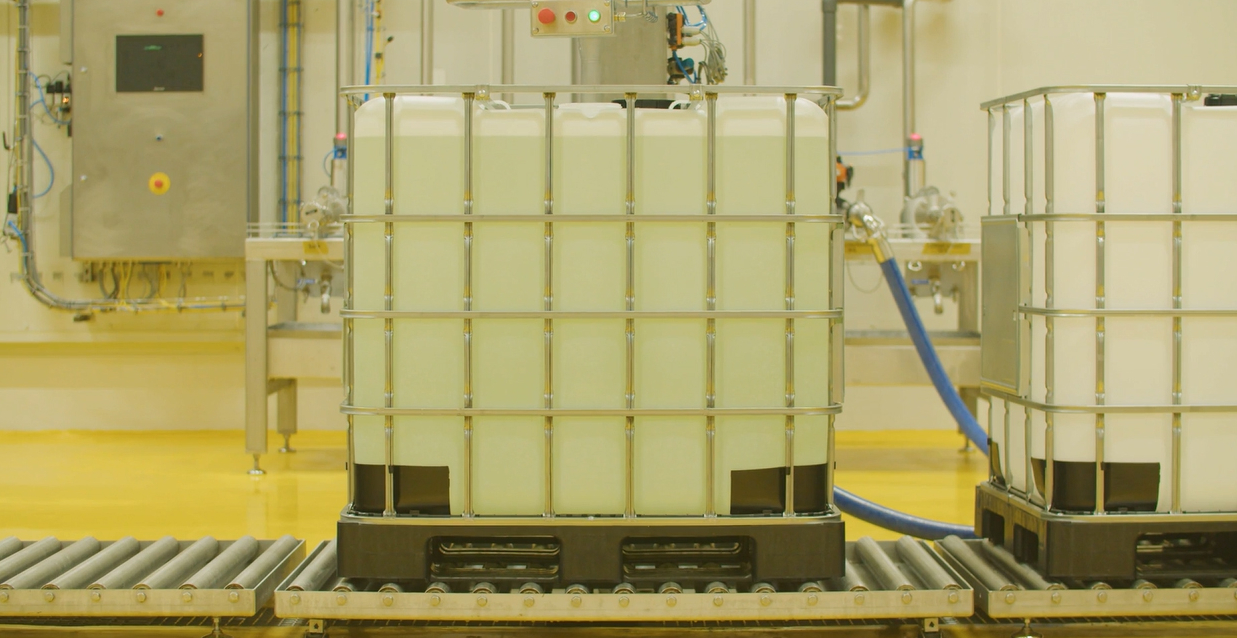
After approval of the product by Quality Control, the product can be filled into a CAN, IBC, Varibox, or bulk tank. To ensure the correct volume, the contents of the IBC or the bullk tank are weighed. At the IBC filling station, the empty and filled packages are properly handled and transported via a roller conveyor. Bulk tanks are filled directly via a closed piping system at a loading and unloading station. Both full bulk tanks and compartment trucks can be filled with the desired amount.
Cleaning the installation
The last step in the process is, of course, cleaning the installation. Proper cleaning prevents contamination between the different products, ensuring food quality.
A spray ball is chosen in the process tanks, which can be connected to the recirculation line. This allows rinsing with demineralized water and the necessary cleaning agents. In the design of the process tanks, special attention was paid to the valves and pipes to avoid dead corners. This way, no product residues remain in the process tanks.
Thanks to the efforts of our process engineers, we not only use a completely new installation where chemistry and Food Safe come together, but also one that is future-proof with various expansion possibilities thanks to our FSSC 22000 certification. This way, we can anticipate the wishes and needs of our customers.
Would you like to know more about our capabilities?